De la mise en culture de la science à la recherche-création
Journées d’études
(Workshop proposal)
ISEA 2023
Organizers
| Samuel Bianchini | Jean-Marc Chomaz | Nicolas Reeves |
ENSADlab
École Nationale Supérieure des Arts Décoratifs
La Chaire arts & sciences de l'École polytechnique, de l'École des Arts Décoratifs-PSL et de la Fondation Daniel et Nina Carasso
LadHyX
CNRS, École Polytechnique
Institut Polytechnique de Paris
La Chaire arts & sciences de l'École polytechnique, de l'École des Arts Décoratifs-PSL et de la Fondation Daniel et Nina Carasso
NXI Gestatio Design Lab
École de Design
Université du Québec à Montréal
Réseau Hexagram de Recherche-Création
en Arts, Culture et Technologie
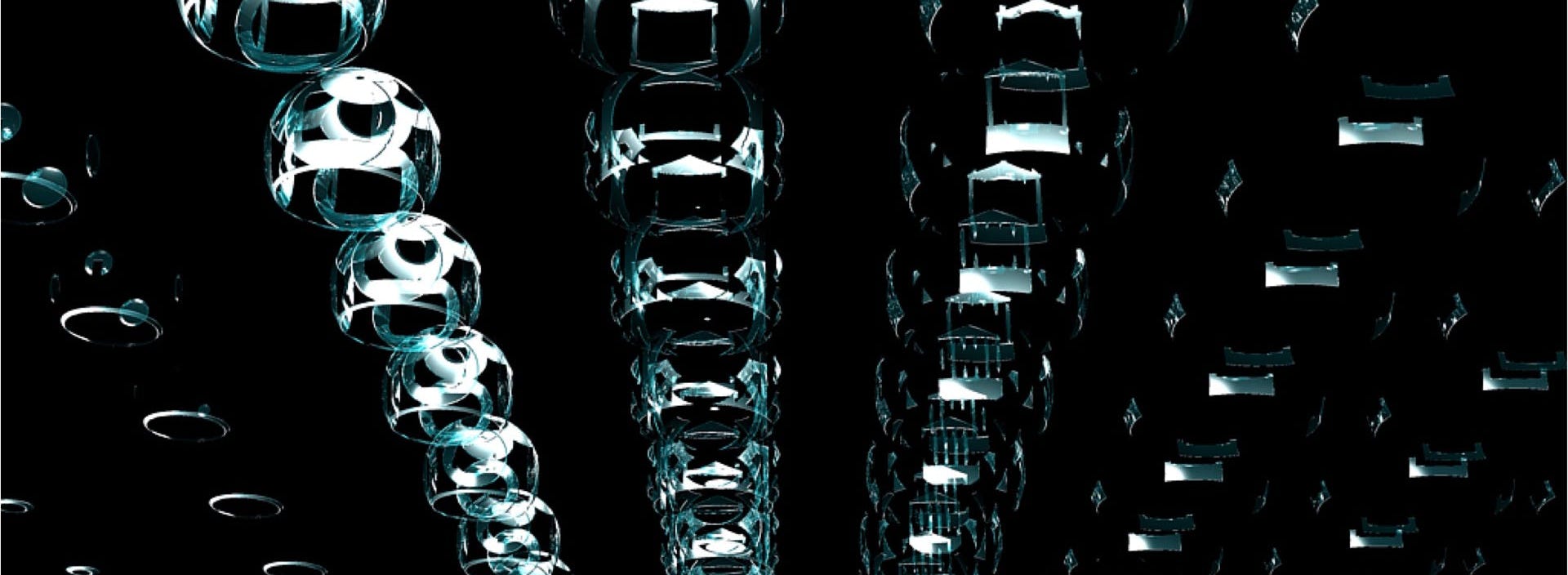
Decomposition in spherical shells of the Villa Almerico Capra, or « Rotonda » (Andrea Palladio, 1566-71).
Nicolas Reeves, Point d.Origine project, 2007
DESCRIPTION
From the mise en culture de la science to the concept of research-creation
As soon as the beginning of the 80’s, French physicist Jean-Marc Lévy-Leblond mentioned the cleavage that existed between scientific circles and society as a whole. Scientific knowledge as such remained confined within laboratories and research environments, or manifested itself through everyday objects incorporating advanced technologies, but whose functioning remained opaque for about everyone, a situation that has only gotten worse since. The channels allowing scientific knowledge to percolate towards general culture, to link up with professional savoir-faire and to integrate into daily practices and activities were and remain largely non-existent.
From a simple embrace, this increased and hermetic technologization of our living environments has gradually evolved into a constraint, further accentuated by the reduction of the time dedicated to science education in schools and colleges. A committed activist, Lévy-Leblond mentioned the importance of re-establishing a dialogue between sciences and the other components of culture, and of conceiving mechanisms and mediation environments intended to transmit to all layers of society the evolution of scientific knowledge, in an approach he then christened Mise en culture de la science. This situation has obviously not improved since: the scientific discourse is struggling to become operational, in a time when its potential for the development of critical thinking and the setting up of enlightened debates would be more than necessary.
In a few places however, such a dialogue has begun to develop, allowing to foresee the possibility of new bridges between disciplines; research-creation presents itself today as one of the most promising of these places. Resulting from the gathering of scattered practices whose convergence can be traced back to the beginning of the 1950s, and which were growing on the borders between science, art and technology, research-creation progressively became a field in its own right with the emergence, some twenty years ago, of the first organizations specifically dedicated to its development, promotion and funding. Gradually stabilized by a first institutional recognition in the early 2000’s, notably in Quebec and Canada, research-creation has deployed in a territory bursting with researches, practices and artistic ventures. It is gradually positioning itself alongside pure and applied research as a valid and rigorous domain of knowledge production whose methodologies, still being constituted, are anchored in a frame of reference centered on the notions of meaning and signification. Although it is generally associated with the academic context, it is characterized by a strong will for social and civic engagement and by the autonomy of its production; its vitality and development depend closely on its openness to collaboration with artistic and cultural circles. Among the many questions it raises, one of the most central is undoubtedly the nature and status of the knowledge it produces, as well as the possibility of aggregating this knowledge into a structured, shareable and teachable corpus, another essential element of its perennity and future evolution.
By re-examining Lévy-Leblond's proposals in the light of the current relations between science, society and culture, this workshop proposes two days of meetings and debates around the notion of research-creation. It will involve, among other things, examining the status of research-creation knowledge, identifying a set of strategies aimed at actualizing its potential as an interface between disciplines and as a vector of knowledge and awareness for all audiences, and as a driving force for the encounter between scientific, artistic, technological and digital knowledge. In terms of format, each day will include three two-hour sessions, each focused on a specific theme. Each session will begin with an introductory note by a guest speaker, followed by interventions of about fifteen minutes by three of the participants of the sessions concerned, all over a period of one hour. The second hour will be devoted to an open discussion with the audience.
PRELIMINARY PROGRAM
Please note that the full program, which includes 24 interventions and which will be posted here soon, will maintain a full parity between male and female speakers.
From the mise en culture de la science to the concept of research-creation
DAY 1
SESSION 1: Historical beacons and technological mutations of the arts
Introductory notes : Nicolas Reeves
Ancient roots and current relevance of a very recent concept
Summary of the origins of the field and of its emergence in the French context, based on the notion of Mise en culture de la science (« Putting science into culture ») introduced by French physicist Jean-Marc Lévy-Leblond in the early 1980s.
SESSION 2: Diversification of practices and methodologies
Arts & sciences : a hybrid phase
Introductory notes: Annick Bureaud
New spaces of extended practices investing the space of science and scientific institutions to create works, question the scientific model, explore its limits and its ethical stakes.
SESSION 3: Training in and through research creation / making discipline
Research-creation : a valid and legitimate mode of knowledge production?
Introductory notes: Jean-Marc Chomaz
The nature and status of knowledge produced by research-creation; their epistemological positioning; question of their transferability and teachability.
CONFERENCE EVENING open to all audiences / reservation required
Guest Speaker : Jean-Marc Lévy-Leblond
DAY 2
SESSION 4: Interactions
The new public interfaces of research-creation
Introductory Notes: Samuel Bianchini
Modes of presence and visitor/spectator engagement determined by the modes of dissemination specific to research-creation
SESSION 5: An incremental birth
The emergence of research-creation: Quebec as a case study
Introductory notes: Louise Poissant
The self-emergence of the concept of research-creation in the Quebec context: the influence and role of artist-researchers
SESSION 6: Research-creation beyond the walls
Taking action / towards new cultural commons
Introductory notes: Guillaume Crédoz
The potential impact of research-creation in action: civic engagement, operationalization of practices, dissemination in the public space